
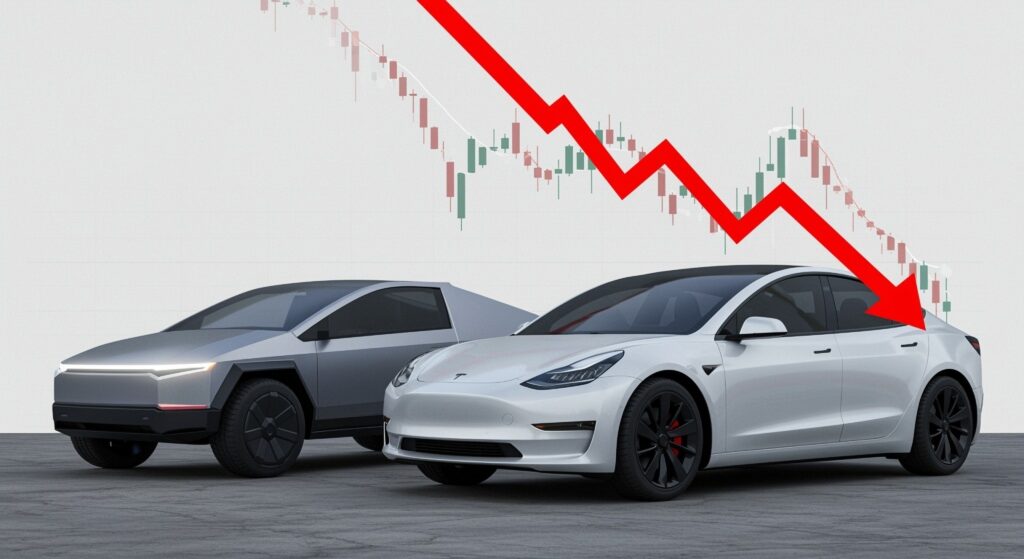
Tesla stock, currently trading around $360-$370 in late March 2026, faces significant downside risk that could push it toward the $240 level, according to several Wall Street analysts and market observers. The electric vehicle giant has seen its shares pull back from recent highs amid softening demand for its core models and growing concerns over execution on ambitious future projects. While Tesla remains a market leader in EVs and energy storage, its sky-high valuation—trading at a forward P/E multiple well above 100—leaves little room for disappointment. Investors are increasingly questioning whether the company’s premium pricing is justified as near-term headwinds mount. A drop to $240 would represent roughly a 35% decline from current levels and align with more conservative valuation models that treat Tesla primarily as an automaker rather than a high-growth tech disruptor.
One of the biggest pressures on Tesla stock comes from declining or stagnant vehicle deliveries. After two consecutive years of falling annual sales, Q1 2026 consensus estimates point to around 365,000 units, reflecting ongoing weakness in key markets like Europe, China, and the United States. Heightened competition from rivals such as BYD, price cuts that have squeezed margins, and the end of certain EV tax incentives have contributed to this slowdown. Analysts warn that if actual Q1 deliveries miss even these lowered expectations, it could trigger fresh selling pressure and force investors to reassess growth projections. Without a clear rebound in core automotive revenue, Tesla’s fundamentals may struggle to support its current market capitalization.
Elon Musk’s polarizing political involvement has also emerged as a notable risk factor, with reports of brand backlash, protests, and vandalism at showrooms in some regions. This anti-Musk sentiment appears to have hurt demand in parts of Europe and among certain consumer segments in the US, exacerbating the sales slump. While Tesla’s energy storage business continues to show strong growth, it is not yet large enough to fully offset weakness in vehicle sales. As long as the CEO’s public profile remains a distraction, some investors fear it could prolong the recovery in deliveries and weigh on the stock price.
Delays and uncertainties surrounding Tesla’s robotaxi and Full Self-Driving (FSD) initiatives represent another critical overhang. The much-anticipated unsupervised autonomy and dedicated Cybercab rollout have been pushed further into 2026 or beyond due to regulatory hurdles, safety concerns, and technical challenges. Many analysts argue that a large portion of Tesla’s current valuation already prices in massive future contributions from autonomy and robotics. If these timelines slip or early deployments disappoint, the stock could face a sharp de-rating as investors shift focus back to the slower-growing EV business.
Heavy capital spending plans for 2026, expected to exceed $20 billion on AI infrastructure, factories, and new technologies, could further pressure free cash flow in the near term. While these investments are aimed at long-term leadership in AI and humanoid robots like Optimus, they raise questions about short-term profitability and returns. With earnings already under pressure from lower automotive margins, any signs of negative or weaker-than-expected free cash flow could accelerate selling by growth-oriented funds. Bears point out that Tesla’s valuation leaves minimal margin of safety if these big bets take longer than expected to pay off.
Finally, broader macroeconomic factors and a potential re-rating of Tesla as a cyclical auto company rather than a pure AI play could drive the stock toward the $240 zone. Some analysts, including those at firms like Wells Fargo and GLJ Research, have highlighted risks of continued earnings declines and argue for much lower multiples more in line with traditional automakers. While bullish voices still see huge upside from robotaxis and energy, the combination of soft deliveries, execution risks, brand challenges, and stretched valuations creates a clear path for significant downside. Investors will be closely watching upcoming Q1 results and any updates on autonomy timelines for fresh signals on whether $240 becomes a realistic target in the months ahead.